PRP & PRF Rejuvenation
PRP & PRF Rejuvenation
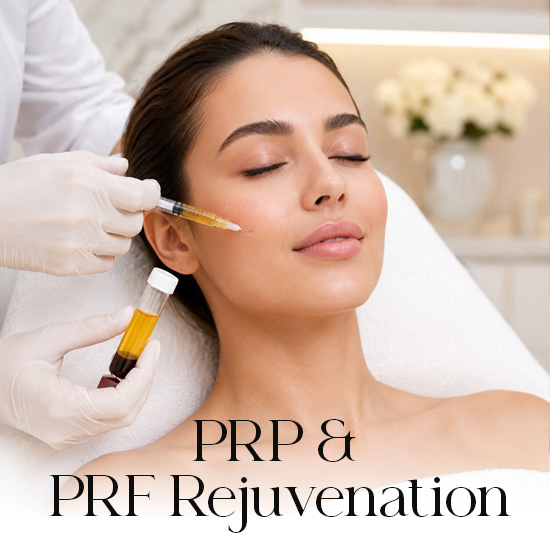
Platelet-rich plasma and platelet-rich fibrin are autologous preparations produced from a sample of the patient’s own blood. Following collection, the blood is processed by centrifugation to isolate a fraction containing a relatively increased concentration of platelets and tissue-repair–associated proteins. Activated platelets can release multiple growth factors and cytokines involved in wound healing, angiogenesis, and extracellular-matrix remodeling. Because the starting material is autologous, allergy to the plasma itself is unlikely; however, the procedure is not free from contamination, inflammatory, injection-related, or product-preparation risks.
PRP and PRF are used in facial rejuvenation with the aim of producing limited, gradual improvement in skin texture, radiance, hydration, fine lines, and overall skin quality. They may be considered for thin or crepey periorbital skin, selected forms of dark circles, and certain superficial changes associated with photodamage. However, individual responses vary substantially. Systematic reviews report promising findings for texture and wrinkles, but marked heterogeneity in preparation and administration prevents the definition of one optimal protocol or predictable clinical result.
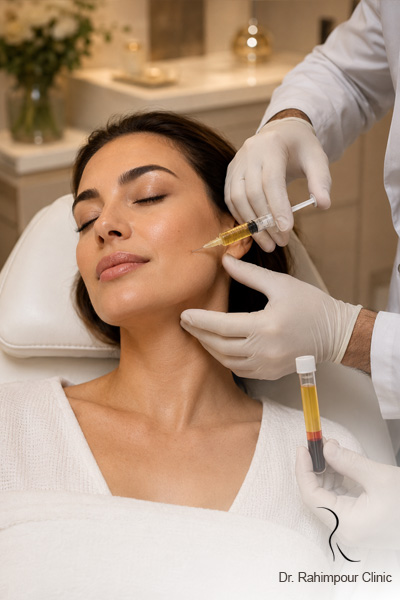
PRP and PRF are not reliable volumizing fillers for deep tear-trough hollowing or major volume deficiency involving the cheeks or temples. Initial swelling or temporary fibrin formation may create short-term fullness, but this should not be confused with the structural volume produced by hyaluronic-acid filler or fat grafting. These treatments also cannot remove eyelid bags, reposition orbital-fat pads, remove excess eyelid skin, or correct significant facial laxity.
Results are generally gradual and may develop over several weeks to months. The degree of improvement may be influenced by age, skin condition, platelet number and function, processing method, final product composition, number of sessions, and combined treatments. Reported improvements are generally modest, and PRP or PRF should not be advertised as guaranteed rejuvenation, complete regeneration, or a permanent treatment.
PRP and PRF: What Is the Difference?
PRP | Platelet-Rich Plasma
PRP is generally prepared by centrifuging blood collected with an anticoagulant. The product remains liquid long enough to be injected or used with another procedure. Its composition varies significantly between preparation systems, including differences in platelet concentration, leukocyte content, red-cell contamination, activation, and final volume.
PRP may be injected intradermally or subdermally or used in combination with selected procedures. It has been studied more extensively than PRF, although there is still no universally accepted standard for the optimal platelet concentration, injection volume, activation method, or number of sessions.
PRF | Platelet-Rich Fibrin
PRF is another autologous platelet concentrate that is commonly prepared without an added anticoagulant or with fewer additives. Consequently, the natural coagulation process begins soon after blood collection. Depending on centrifugation speed and duration, it may be prepared as injectable PRF, liquid PRF, or a platelet-rich fibrin matrix.
A fibrin network may retain platelets and leukocytes and permit a more gradual release of selected signaling molecules. This proposed mechanism does not, by itself, prove that PRF produces superior clinical outcomes to PRP.
Injectable PRF | i-PRF
Injectable PRF remains liquid for a limited period after centrifugation and must be used before complete fibrin clot formation. The timing of blood collection, processing, transfer, and injection is therefore particularly important.
Platelet-Rich Fibrin Matrix
A platelet-rich fibrin matrix has a more gel-like or clot-like consistency and may provide temporary tissue support or be used with selected surgical procedures. It is not a standardized volumizing filler with predictable projection or longevity. Early apparent fullness may diminish as the fibrin matrix remodels.
Recent comparative evidence suggests that both PRP and PRF may improve selected periorbital skin parameters, but studies remain few and protocols highly variable. A 2025 systematic review associated PRF with improvements in skin texture, wrinkles, and crepiness, while PRP had comparatively stronger evidence for selected pigmentation outcomes. These findings are not sufficient to establish definite superiority of one product.
Potential Indications
• Limited improvement in skin texture and softness
• Modest improvement in radiance
• Limited reduction of fine lines
• Improvement of selected crepey periorbital skin
• Possible improvement in selected causes of periorbital darkness
• Adjunctive improvement in facial, neck, and décolletage skin quality
• Combination with microneedling or selected laser procedures
• Possible support of healing after selected procedures when an appropriate protocol is used
• Use with fat grafting in selected techniques, without proof of improved graft survival in every setting
• Scalp treatment for selected hair-loss disorders, which should be discussed separately
Concerns PRP and PRF Do Not Reliably Correct
• Significant excess eyelid skin
• Prominent orbital-fat bags
• Deep hollowing caused by structural volume loss
• Moderate-to-severe facial or neck laxity
• Marked dynamic wrinkles
• Deep wrinkles or scars
• Resistant melasma or deep pigmentation
• Significant cheek, chin, jawline, or temporal volume deficiency
• A result equivalent to dermal filler, fat grafting, or facelift surgery
• Absent hair follicles or uncontrolled scarring alopecia
Procedure Essentials
Session Duration
Usually approximately 30–60 minutes, including blood collection, processing, and injection
Anesthesia
Commonly topical or local anesthesia, depending on area and technique
Recovery Timeline
Usually several hours to a few days of redness, swelling, tenderness, or bruising
Aesthetic Results
Gradual; improvement may begin over several weeks and is better assessed after several months
Longevity
Temporary and variable; the duration of benefit is not clearly established
Repeat Interval
No universal protocol; initial sessions are commonly separated by several weeks
Clinical Considerations
Correct diagnosis, platelet count and function, preparation system, sterility, injection plane, and volume
Number of Sessions
Often 2–4 initial treatments; no fixed evidence-based number applies to every patient
Facial PRP and PRF Aftercare
• Follow Individual Instructions: Product-, technique-, and area-specific instructions take priority over general recommendations.
• Touching and Pressure: Avoid repeated touching, rubbing, pressure, and massage during the initial hours.
• Cleansing: Cleanse the skin at the advised time using lukewarm water and a gentle cleanser.
• Makeup: Delay makeup until injection sites have closed and according to medical advice.
• Injection Papules: Small superficial bumps may remain visible for several hours or days; do not squeeze or manipulate them.
• Swelling: Mild-to-moderate swelling may occur and can be more noticeable in the periorbital area.
• Bruising: Limited bruising may occur at the venipuncture or injection sites.
• Cold Compresses: When approved, use gentle indirect cooling without firm pressure.
• Head Elevation: Following periorbital treatment, slight head elevation during the first night may reduce swelling.
• Sleeping Position: Avoid direct pressure over the treated area during the first night.
• Exercise: Avoid strenuous exercise and excessive sweating on the day of treatment and for the recommended period.
• Excessive Heat: Avoid saunas, hot tubs, facial steaming, and very hot showers during early recovery.
• Sun Exposure: Limit direct sun exposure and use broad-spectrum sunscreen once injection sites have closed.
• Active Skincare: Temporarily avoid retinoids, AHA/BHA products, benzoyl peroxide, scrubs, and irritating skincare.
• Alcohol: Alcohol may increase flushing, swelling, and bruising and is best limited around treatment.
• Smoking: Smoking and nicotine may adversely affect circulation and tissue-repair processes.
• Medication: Take prescribed medication exactly as directed.
• NSAIDs: Ask the treating physician about ibuprofen, naproxen, and other NSAIDs. Do not stop or begin them without appropriate advice.
• Blood-Thinning Medication: Never discontinue prescribed aspirin, anticoagulants, or antiplatelet medication without approval from the prescribing physician.
• Other Procedures: Delay facial massage, RF, HIFU, laser, chemical peeling, filler, and Botox for the medically recommended interval.
• Early Fullness: Post-injection swelling is not the final treatment result and should not be interpreted as durable volume.
• Final Assessment: Results should be assessed with standardized photographs after an appropriate period.
• Follow-up: Review may be recommended to assess skin response, symmetry, nodules, infection, and the timing of further sessions.
Warning Signs
Seek prompt medical assessment for:
• Severe, unusual, or progressively increasing pain
• Severe, one-sided, or progressive swelling
• Spreading redness, warmth, discharge, fever, or chills
• A painful mass, abscess, or increasing firmness
• Blistering, ulceration, skin breakdown, or abnormal discoloration
• White, purple, gray, or black discoloration
• Severe headache, dizziness, fainting, or unusual weakness
• Palpitations or breathing difficulty
• Lip or tongue swelling, urticaria, wheezing, or severe allergic symptoms
• Persistent numbness or neurological weakness
• Visual disturbance, blurred vision, double vision, or ocular pain
• Prolonged bleeding from a venipuncture or injection site
Contraindications & Precautions
Contraindications should be assessed according to the patient’s general health, blood-cell count and function, the anticoagulant or activator used, and any combined procedure.
Principal Contraindications
• Active infection at the blood-draw or treatment site
• Systemic infection, sepsis, or active febrile illness
• Severe or uncontrolled platelet or coagulation disorder
• Severe thrombocytopenia
• Hemodynamic instability or uncontrolled systemic illness
• Known hypersensitivity to a required anticoagulant, activator, local anesthetic, or procedural component when no safe alternative is available
• Inability to collect, process, or inject the product under appropriate sterile conditions
• Use of collection tubes, kits, or products with unknown origin or sterility
• Any preparation-system– or medication-specific contraindication
Conditions Requiring Additional Caution or Medical Assessment
• Pregnancy: Elective aesthetic treatment is generally postponed until after pregnancy.
• Breastfeeding: Treatment should be considered according to anesthetic use, associated medication, and individual circumstances.
• Moderate-to-severe anemia or low hemoglobin
• Low platelet count or impaired platelet function
• Known hematological disease
• Anticoagulant or antiplatelet therapy
• NSAID use or other medication affecting platelet function
• Active or uncontrolled autoimmune or connective-tissue disease
• Immunosuppression
• Uncontrolled diabetes
• Significant liver disease that may impair coagulation
• Significant renal or cardiac disease
• Previous severe vasovagal reaction or syncope during blood collection
• History of keloid or hypertrophic scarring
• Active dermatitis, eczema, severe rosacea, or inflammatory acne at the treatment site
• Active herpes simplex infection; prophylaxis may be considered in patients with recurrent disease.
• Recent surgery, laser, chemical peeling, RF, or other treatment in the same area
• Previous significant reaction to PRP or PRF
• Active malignancy or a history of cancer, particularly involving the proposed treatment region; specialist evaluation may be appropriate.
• Unrealistic expectations, including an expectation of filler-like volume
• Inability to complete the treatment plan and follow-up
Cancer-Related Considerations
PRP and PRF contain multiple mediators associated with tissue repair and cellular signaling. Evidence is insufficient to establish the safety of elective aesthetic treatment in active malignancy. In patients with active cancer, a suspicious lesion, or recent cancer treatment, elective use should generally be postponed or considered only after discussion with the treating oncologist.
Medication Considerations
Discontinuing aspirin, clopidogrel, warfarin, direct oral anticoagulants, or other prescribed antithrombotic medication solely for PRP treatment may create serious medical risk. Prescribed medication should never be stopped without approval from the responsible physician. When medication makes the product quality or bleeding risk unsuitable, postponing an elective treatment is generally safer than unsupervised medication withdrawal.
Potential Adverse Effects
Common and usually temporary effects include discomfort during blood collection or injection, redness, swelling, tenderness, itching, bruising, small papules, and a feeling of pressure or tightness. Periorbital swelling may be more pronounced and persist for several days.
Less common complications include hematoma, infection, folliculitis, abscess, nodules, granuloma, prolonged inflammation, post-inflammatory hyperpigmentation, localized nerve injury, and scarring. Contamination during collection, processing, transfer, or injection may produce serious infection, making sterile preparation and handling essential.
Allergy to the patient’s own plasma is highly unlikely, but reactions to local anesthetics, anticoagulants, activators, antiseptics, adhesives, or disposable equipment remain possible. Blood collection may also cause dizziness, hypotension, vasovagal syncope, or hematoma.
Despite the autologous nature of the product, facial injection retains the risks associated with needles and cannulas. Severe pain, vascular discoloration, or visual symptoms should never be dismissed as a normal response to PRP or PRF.
Important: PRP and PRF may provide limited and gradual improvement in selected skin-quality parameters, but preparation methods and clinical outcomes remain heterogeneous. Terms such as “stem-cell facial,” “complete regeneration,” “guaranteed collagen production,” “permanent dark-circle removal,” or “non-surgical lifting” are not scientifically appropriate descriptions of these treatments.
Explore Our Non-Surgical Treatments
Advanced minimally inasive solutions to refresh, restore and refine your natural beauty.

Patient Testimonials
Refined Results. Confident Experiences.


Answers to Common Questions
The most suitable treatment depends on your facial anatomy, skin condition, aesthetic goals, and medical history. During consultation, the treatment plan is tailored to your needs to ensure natural-looking and medically appropriate results.
Most non-surgical treatments involve minimal discomfort. Depending on the procedure, topical numbing, local anesthesia, or comfort measures may be used to improve the treatment experience.
Downtime varies depending on the treatment. Some procedures allow an immediate return to daily activities, while others may involve temporary redness, swelling, bruising, or sensitivity for a short period.
Some treatments provide visible improvement shortly after the session, while others develop more gradually over several days or weeks. The timing depends on the treatment type and the body’s natural response.
The longevity of results varies based on the procedure, treatment area, skin quality, and individual metabolism. Some treatments may last several months, while others may require periodic maintenance for optimal results.