Subcision for Acne and Depressed Scars
Subcision for Acne and Depressed Scars
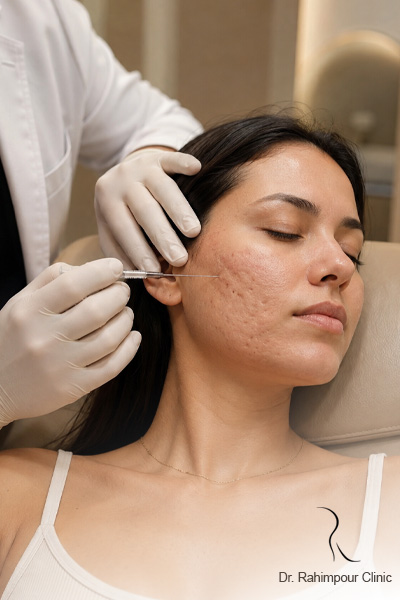
Subcision is a minimally invasive surgical procedure used to improve selected depressed scars that are tethered to deeper tissues. A needle, cannula, or specialized instrument is introduced through a small entry point and passed beneath the scar to release the fibrous bands pulling the skin surface downward. Releasing these attachments allows the scar to elevate. Controlled subdermal injury and bleeding may also stimulate connective-tissue formation and collagen remodeling beneath the scar.
Subcision is most useful for rolling and tethered scars with sloping borders and an undulating appearance. It is generally not the primary treatment for narrow deep ice-pick scars or sharply defined deep boxcar scars, which may require TCA CROSS, punch excision, punch elevation, laser resurfacing, or combination treatment.
The outcome cannot be judged immediately. Early swelling or bruising may temporarily make the skin appear smoother, while the meaningful result develops over subsequent weeks and months as inflammation subsides and tissue remodeling occurs. Many patients require more than one session or a combination of subcision with resurfacing or volume-restoration techniques. No treatment completely erases acne scars, and response varies according to scar depth, degree of tethering, skin quality, and previous treatment.
Correct patient selection and treatment-plane control are essential. Treatment that is excessively superficial may produce visible injury, depression, or entry-track irregularity. Excessively deep or aggressive treatment may increase the risk of bleeding, hematoma, nerve or vascular injury, and contour deformity. Evaluation should include scar type, vascular and neural anatomy, skin type, previous fillers or surgery, and the patient’s risk of post-inflammatory hyperpigmentation or abnormal scarring.
Scars Most Suitable for Subcision
Subcision may be considered for:
• Rolling acne scars
• Tethered scars that partially flatten when the skin is stretched
• Selected depressed traumatic or surgical scars with fibrous attachment
• Some superficial boxcar scars with a tethered component
• Depressed scars associated with limited subcutaneous volume deficiency
• Scars that remain depressed after resurfacing because of deep attachment
Scars Less Likely to Respond
• Narrow deep ice-pick scars
• Deep sharply marginated boxcar scars
• Hypertrophic scars
• Keloids
• Raised scars
• Pigmentary scars without depression or tethering
• Enlarged pores without fibrous attachment
• Conventional wrinkles
• Active inflamed or infected acne scars
• Broad facial volume loss without localized tethering
TCA CROSS, punch techniques, laser resurfacing, microneedling, filler, fat grafting, or other treatments may be more appropriate in these situations.
Techniques and Instruments
Needle Subcision
Classic subcision uses a specialized needle, such as a Nokor or other appropriate needle, to divide fibrous attachments beneath individual scars. It may be useful for focal or strongly tethered scars but can produce more bruising and hematoma.
Cannula Subcision
A blunt-tipped cannula may be introduced through a small access point to treat a broader region. Cannulas may reduce direct penetration of some vessels, although safety still depends on anatomy, depth, instrument size, and technique.
Wire or Blunt-Dissector Subcision
Wire or blunt dissection techniques may be used for extensive or severe tethering. These procedures may be more invasive and can involve greater bruising, swelling, or recovery.
Multi-Plane or Dual-Plane Subcision
Some scars are tethered at more than one depth and may require treatment within separate tissue planes. Recent evidence indicates that broader and deeper rolling scars generally respond better than boxcar scars, but multi-plane treatment must be selected carefully according to regional anatomy and risk.
Combination Treatments
Subcision With Hyaluronic Acid Filler
Following release, conservative filler placement may support the elevated scar and correct associated volume deficiency. Potential filler complications include lumps, edema, Tyndall effect, vascular occlusion, and skin necrosis.
Subcision With Fat Grafting
Fat grafting may be considered for extensive scars associated with soft-tissue loss. Fat retention is variable, and complications may include fat necrosis, nodules, asymmetry, and the need for revision.
Subcision With PRP or PRF
PRP or PRF may be used as an adjunct in selected protocols. Some studies report added improvement, but processing methods and evidence remain heterogeneous, and additional benefit cannot be guaranteed.
Subcision With Microneedling or RF Microneedling
Subcision releases deeper fibrous attachments, while microneedling or RF microneedling targets dermal remodeling and surface texture. This combination may benefit mixed scar patterns but may also increase inflammation, downtime, and the risk of pigmentary change.
Subcision With Fractional Laser
After deep tethering has been released, fractional CO₂, Er:YAG, or non-ablative fractional laser may improve scar edges and surface texture. Timing should be individualized to limit excessive inflammation and post-inflammatory hyperpigmentation.
Subcision With TCA CROSS or Punch Techniques
Patients commonly have mixed rolling, ice-pick, and boxcar scars. Subcision may be used for tethered scars, while TCA CROSS or punch techniques address narrow or sharply marginated scars.
How Treatment Is Performed
Tethered scars are identified and marked under appropriate direct and oblique lighting, sometimes while the skin is stretched or moved. The area is cleansed and local anesthesia is administered. A needle, cannula, or selected instrument is then introduced into the appropriate tissue plane to release fibrous bands with controlled movements.
A subtle cutting or popping sensation may be felt as attachments are released. Limited subdermal bleeding contributes to early tissue elevation, but excessive bleeding and a large hematoma are not intended outcomes. Gentle compression, a small dressing, or an adjunctive treatment may be used after completion.
Treatment GRID Information:
Session Duration
Usually approximately 30–60 minutes, depending on the number and extent of scars
Anesthesia
Local anesthesia, sometimes combined with topical anesthesia
Recovery Timeline
Commonly 3–10 days of visible swelling and bruising; longer after extensive treatment
Aesthetic Results
Gradual; improvement is better assessed over several weeks to months
Longevity
Successfully released bands may remain improved long term, although retethering or recurrent depression may occur
Repeat Interval
After inflammation has resolved and the result has been assessed; commonly approximately 6–12 weeks or longer
Clinical Considerations
Scar type, tethering depth, vascular and neural anatomy, skin type, and previous treatment
Number of Sessions
Commonly 1–3 or more sessions depending on severity and combination treatment
Subcision Aftercare
• Follow Individual Instructions: Technique- and combination-treatment instructions take priority over general advice.
• Initial Compression: Apply gentle compression only when advised to limit bleeding and hematoma. Avoid prolonged firm pressure.
• Cold Compresses: Gentle indirect cooling may be used during the first hours if approved. Do not place ice directly on the skin.
• Head Elevation: Sleep with the head slightly elevated during the first night or several nights.
• Sleeping Position: Avoid direct pressure over treated areas.
• Swelling: Mild-to-moderate swelling is common and may peak during the first 24–72 hours.
• Bruising: Bruising is expected and may persist for one to two weeks or longer.
• Discomfort: Mild-to-moderate soreness, tenderness, or a bruised sensation may occur. Use recommended analgesia.
• Massage: Do not massage the area unless specifically instructed.
• Entry Sites: Keep needle or cannula access points clean and dry.
• Cleansing: Cleanse gently at the recommended time without scrubbing.
• Makeup: Resume makeup only after entry sites have closed.
• Do Not Manipulate: Do not squeeze a firm, swollen, or bruised area or attempt to drain it.
• Exercise: Avoid strenuous exercise, prolonged bending, and activities that increase blood pressure or swelling during early recovery.
• Excessive Heat: Avoid saunas, hot tubs, very hot showers, and direct steaming until inflammation has settled.
• Sun Exposure: Avoid direct sun and use broad-spectrum sunscreen after entry sites have closed.
• Active Skincare: Temporarily avoid retinoids, AHA/BHA products, scrubs, benzoyl peroxide, and irritating skincare.
• Hair Removal: Postpone waxing, threading, dermaplaning, and harsh shaving until healing is complete.
• Alcohol: Alcohol may increase bruising and swelling and is best limited around treatment.
• Nicotine: Smoking and nicotine may impair circulation and tissue repair.
• Medication: Take prescribed analgesics, antibiotics, or other medication exactly as directed.
• Antithrombotic Medication: Do not stop or begin aspirin, NSAIDs, anticoagulants, or antiplatelet drugs without approval from the prescribing physician.
• Other Procedures: Delay laser, peeling, microneedling, RF, filler, and other procedures for the recommended interval.
• Firmness or Nodules: Limited firmness related to hematoma or healing may occur, but persistent or painful lumps require assessment.
• Early Appearance: Temporary smoothing caused by swelling is not the final result.
• Follow-up: Attend follow-up to assess hematoma, infection, pigmentary change, symmetry, and the need for further treatment.
Warning Signs
Contact the treating physician promptly for:
• Severe, unusual, or progressively increasing pain
• Severe, firm, or one-sided swelling
• A large or expanding hematoma
• Persistent bleeding from an entry point
• Spreading redness, warmth, purulent drainage, fever, or chills
• An abscess or painful enlarging mass
• White, purple, gray, or black skin discoloration
• Cool skin or mottled/reticular discoloration
• Blistering, ulceration, or skin breakdown
• Severe or progressive numbness
• New facial-muscle weakness or dynamic asymmetry
• Electric-shock pain or other neurological symptoms
• A new deep depression or major contour irregularity
• Severe headache, visual disturbance, or other neurological symptoms
• Lip or tongue swelling, urticaria, or breathing difficulty
When filler or fat grafting is performed at the same session, any visual or neurological symptom is a medical emergency.
Contraindications & Precautions
Principal Contraindications
• Active infection within the treatment area
• Severe or uncontrolled inflammatory or cystic acne in the proposed area
• Open wounds, ulceration, or significant skin-barrier disruption
• Severe or uncontrolled coagulation disorder
• An uncontrolled medical condition that makes elective treatment unsafe
• Inability to provide sterile treatment or comply with aftercare
• Severe hypersensitivity to required local anesthetic or procedural materials when no safe alternative exists
• An undiagnosed or suspicious lesion incorrectly assumed to be a scar
Conditions Requiring Additional Caution
• Pregnancy: Elective cosmetic treatment is generally postponed.
• Breastfeeding: Anesthesia and associated medication should be considered individually.
• Bleeding disorders
• Anticoagulant or antiplatelet treatment
• Thrombocytopenia or impaired platelet function
• Previous large hematoma or prolonged bleeding
• Liver disease affecting coagulation
• Uncontrolled diabetes
• Immunosuppression
• Active autoimmune or connective-tissue disease
• History of keloid or hypertrophic scarring
• Fitzpatrick skin types IV–VI or a history of post-inflammatory hyperpigmentation
• Active herpes or recurrent skin infection
• Active dermatitis, eczema, or inflammation
• Permanent filler, silicone, biopolymer, or unknown injectable material along the treatment plane
• Previous filler, fat grafting, thread lifting, or surgery within the region
• Facial implants, plates, screws, or mesh near the treatment plane
• Previous facial palsy, nerve injury, or sensory abnormality
• Scars close to the facial nerve, parotid duct, or important vessels
• Very thin skin or severe loss of subcutaneous tissue
• Current or recent isotretinoin use; timing should be individualized according to skin condition and combined treatment.
• Previous poor healing, infection, or a severe treatment reaction
• Unrealistic expectations or an expectation of complete scar removal
• Untreated body dysmorphic disorder or psychological illness affecting informed consent
Bleeding disorders and medication that prolongs bleeding may increase the likelihood of hematoma and persistent fibrous nodules. Essential prescribed medication should never be stopped without approval from the prescribing physician.
Potential Adverse Effects
Common and usually temporary effects include pain, tenderness, swelling, bruising, pinpoint bleeding, temporary numbness, and subcutaneous firmness. A recent review identified pain or tenderness, bruising, infection, subcutaneous lumps, and dyspigmentation among the principal reported complications of acne-scar subcision.
Less common complications include:
• Large or persistent hematoma
• Organized fibrous nodule formation
• Infection or abscess
• Post-inflammatory hyperpigmentation or hypopigmentation
• A new depression or contour irregularity
• Persistent asymmetry
• Temporary or permanent nerve injury
• Vascular injury
• Injury to the parotid duct or other deeper structures
• Skin necrosis
• Entry-point scarring
• Hypertrophic scar or keloid
• Retethering and recurrent depression
• Inadequate improvement or need for further treatment
Persistent hematoma and organized subcutaneous fibrous nodules have also been reported in earlier clinical literature.
When subcision is combined with filler, fat grafting, PRP, laser, or RF, the specific adverse effects of the additional treatment must also be considered.
Scientific Perspective
• Subcision is primarily designed for rolling and tethered scars.
• It is not the main treatment for ice-pick, keloid, or raised scars.
• It improves scars but does not remove them completely.
• Early smoothing caused by swelling is not the final result.
• Multiple sessions or combination treatment are commonly required.
• Response depends strongly on scar morphology and the degree of tethering.
• More aggressive release does not necessarily produce a better result and may increase complications.
• Filler or PRP is not required for every patient.
• Active acne and inflammation should be controlled before elective scar treatment.
• Standardized photography and assessment under appropriate lighting are important for evaluating results.
Important: The objective of subcision is to release deep fibrous attachment and reduce scar depression—not to create completely smooth, scar-free skin. The best outcomes depend on correct scar classification and using a suitable treatment for each component of a mixed scar pattern.
Explore Our Non-Surgical Treatments
Advanced minimally inasive solutions to refresh, restore and refine your natural beauty.













Patient Testimonials
Refined Results. Confident Experiences.

Answers to Common Questions
The most suitable treatment depends on your facial anatomy, skin condition, aesthetic goals, and medical history. During consultation, the treatment plan is tailored to your needs to ensure natural-looking and medically appropriate results.
Most non-surgical treatments involve minimal discomfort. Depending on the procedure, topical numbing, local anesthesia, or comfort measures may be used to improve the treatment experience.
Downtime varies depending on the treatment. Some procedures allow an immediate return to daily activities, while others may involve temporary redness, swelling, bruising, or sensitivity for a short period.
Some treatments provide visible improvement shortly after the session, while others develop more gradually over several days or weeks. The timing depends on the treatment type and the body’s natural response.
The longevity of results varies based on the procedure, treatment area, skin quality, and individual metabolism. Some treatments may last several months, while others may require periodic maintenance for optimal results.