
Skin Boosters & Biostimulators

Skin Boosters & Biostimulators

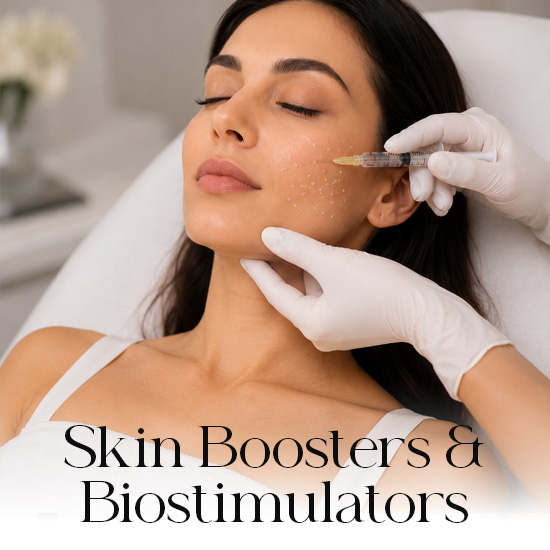
Skin booster is a broad term describing injectable treatments intended to improve hydration, radiance, texture, and fine lines. It is not a single standardized pharmaceutical category. Products marketed as skin boosters may differ substantially in composition, concentration, cross-linking, injection depth, mechanism, clinical evidence, and regulatory status.
Skin boosters are generally not designed to create major cheek projection, lip shape, or deep structural volume. Their principal objective is limited improvement in skin quality. Biostimulators, by contrast, act primarily through a controlled tissue response and gradual collagen production.
Treatment may be used on the face, neck, décolletage, hands, and selected areas of thin or dehydrated skin. Results are usually subtle and gradual and should not be presented as equivalent to surgical lifting, aggressive resurfacing, or major volume restoration.

Skin Boosters & Biostimulators

Skin Booster vs Filler vs Biostimulator

Skin Booster

Primarily intended for:
• Hydration
• Radiance
• Fine superficial lines
• Softness and texture
• General skin-quality improvement

Dermal Filler

Primarily intended for:
• Structural volume restoration
• Facial contouring
• Correction of deeper folds or depressions
• Lip, cheek, chin, or jawline shaping

Biostimulator

Primarily intended for:
• Gradual collagen stimulation
• Improvement in dermal thickness or firmness
• Limited correction of diffuse tissue-quality loss

Types of Skin Boosters

Non-Cross-Linked Hyaluronic Acid

Non-cross-linked HA may improve hydration and softness but is generally less persistent than cross-linked volumizing filler. A 2025 meta-analysis found improvement in hydration and radiance but not significant improvement in elasticity or melanin index compared with controls.

Stabilized or Lightly Cross-Linked HA

These products may persist longer within the skin while remaining intended primarily for skin quality rather than projection. Selected clinical trials have reported improved hydration, superficial wrinkles, and radiance, although results from one formulation cannot be generalized to all products.

HA Combined With Amino Acids, Vitamins, or Antioxidants

The presence of vitamins or amino acids does not independently prove clinical benefit. Product-specific composition, sterility, regulatory status, and evidence should be reviewed.

Polynucleotides and PDRN

These products are used for hydration, tissue quality, and selected fine-line concerns. Early evidence is promising but remains limited and product-dependent. They should not be described as stem-cell or exosome therapy.

Bio-Remodeling HA Products

Selected high-concentration HA products use specific anatomical injection patterns and differ from conventional mesotherapy and volumizing filler.

Types of Biostimulators

Calcium Hydroxylapatite | CaHA

CaHA may provide limited initial structural support and stimulate gradual collagen production. It may be used undiluted for contouring or diluted/hyperdiluted for selected skin-quality indications.
It is not generally appropriate for the lips, tear trough, or very superficial placement and cannot be dissolved with hyaluronidase.

Poly-L-Lactic Acid | PLLA

PLLA stimulates gradual collagen formation. Results develop over weeks to months and commonly require a treatment series.

Polycaprolactone | PCL

PCL is used in selected markets as a longer-lasting filler and biostimulator. Availability, approval, evidence, and management options vary between countries.

Injectable Collagen and Other Collagen-Stimulating Products

These products differ according to biological source, allergy risk, duration, mechanism, and evidence.

Potential Treatment Areas

• Face
• Neck
• Décolletage
• Dorsal hands
• Selected fine perioral lines
• Thin or crepey skin
• Selected superficial scars as adjunctive treatment
• Periorbital skin with appropriate product and patient selection

Concerns Not Reliably Corrected

• Moderate-to-severe facial or neck laxity
• Significant excess eyelid skin
• Prominent eyelid bags or festoons
• Deep tear-trough hollowing
• Major cheek or temple volume loss
• Dynamic wrinkles
• Deep scars or wrinkles
• Resistant melasma or deep pigmentation
• Skeletal asymmetry
• Major chin or jawline contour deficiency

Procedure Essentials

Session Duration

Usually 20–60 minutes

Anesthesia

Commonly topical or local anesthesia

Recovery Timeline

Minimal downtime; papules, redness, swelling, or bruising may persist for several hours to days

Aesthetic Results

Skin boosters: days to weeks; biostimulators: weeks to months

Longevity

Temporary and product-dependent

Repeat Interval

Product-specific; initial sessions are often spaced several weeks apart

Clinical Considerations

Product characteristics, tissue plane, skin thickness, edema history, vascular anatomy, and previous injectables

Number of Sessions

Skin boosters often 2–4 sessions; biostimulators commonly 1–3 sessions depending on product

Skin Boosters & Biostimulators Aftercare

• Avoid unnecessary touching, rubbing, pressure, and massage.
• Massage only when specifically required for the selected product.
• Do not squeeze or puncture injection papules.
• Cleanse gently with lukewarm water and mild skincare.
• Delay makeup until injection sites have closed.
• Temporarily avoid retinoids, AHA/BHA products, scrubs, and irritating skincare.
• Use broad-spectrum sunscreen.
• Avoid strenuous exercise and excessive sweating on the day of treatment.
• Avoid saunas, hot tubs, steaming, and excessive heat.
• Limit alcohol around treatment.
• Avoid direct facial pressure during the first night.
• Avoid facial massage, gua sha, and facial rollers until cleared.
• Delay laser, RF, HIFU, microneedling, and chemical peeling.
• Discuss timing of invasive dental treatment.
• Do not stop prescribed antithrombotic medication without medical approval.
• Do not judge early asymmetry or swelling as the final result.
• Allow adequate time for collagen stimulation before considering additional treatment.
• Follow product-specific massage instructions after PLLA.
• Attend follow-up for edema, nodules, symmetry, and response.

Warning Signs

Seek immediate medical assessment for:
• Severe or progressively increasing pain
• Blanching or marked skin paleness
• Mottled, purple, or reticular discoloration
• Cool skin
• Blistering, ulceration, or darkening
• Severe or progressive one-sided swelling
• Spreading redness, warmth, drainage, or fever
• Painful inflammatory nodules
• Persistent firm lumps
• Blue-gray discoloration following HA treatment
• Blurred vision, double vision, visual loss, or ocular pain
• Sudden eyelid drooping, severe headache, or neurological symptoms
• Urticaria, lip or tongue swelling, wheezing, or breathing difficulty
Any visual symptom following facial injection is a medical emergency.

Contraindications & Precautions

Principal Contraindications

• Active infection within the treatment area
• Open wounds or severe active inflammation
• Known hypersensitivity to the active product or formulation components
• Lidocaine allergy when a lidocaine-containing product is used
• Severe or uncontrolled coagulation disorder
• Products of unknown origin, sterility, composition, or authorization
• Uncontrolled systemic illness
• Product-specific contraindications

Conditions Requiring Additional Caution

• Pregnancy or breastfeeding
• Previous anaphylaxis or multiple drug allergies
• Active autoimmune or connective-tissue disease
• Immunosuppression
• Uncontrolled diabetes
• Anticoagulant or antiplatelet therapy
• Recurrent herpes
• Active dermatitis, eczema, severe rosacea, or inflammatory acne
• Previous granuloma or delayed inflammatory reaction
• Permanent filler, silicone, biopolymer, or unknown material
• Recent filler, thread lifting, fat grafting, laser, or surgery
• Malar edema or impaired lymphatic drainage
• Very thin skin
• Keloid or hypertrophic-scar history
• Active ocular disease before periorbital treatment
• Unrealistic expectations

Potential Adverse Effects

Common temporary effects include:
• Injection discomfort
• Redness
• Swelling
• Bruising
• Tenderness
• Itching
• Small papules
• Early asymmetry
Less common complications include:
• Persistent edema
• Malar edema
• Tyndall effect
• Lumps or nodules
• Granuloma
• Delayed inflammatory reaction
• Infection or abscess
• Herpes reactivation
• Migration or contour irregularity
• Post-inflammatory pigmentation
• Product visibility or palpability
• Need for hyaluronidase or surgical correction
Rare serious complications include:
• Vascular occlusion
• Ischemia
• Skin necrosis
• Nerve injury
• Visual impairment or blindness
• Stroke

Important: Skin boosters and biostimulators are intended to provide limited and natural improvement in skin quality. They do not produce a facelift, eliminate significant laxity, or guarantee permanent skin regeneration.

Explore Our Non-Surgical Treatments

Advanced minimally inasive solutions to refresh, restore and refine your natural beauty.

Patient Testimonials

Refined Results. Confident Experiences.

“From consultation to treatment, the experience was handled with professionalism and care. The final result felt elegant and beautifully balanced.

Patient 1
“I valued the clarity, precision, and thoughtful approach throughout the process. The outcome was subtle yet noticeable in the best possible way.”

Patient 2
“The treatment was efficient, comfortable, and tailored to my concerns. I especially appreciated the natural-looking result and the clinic’s refined attention to detail.”

Patient 3

Answers to Common Questions

The most suitable treatment depends on your facial anatomy, skin condition, aesthetic goals, and medical history. During consultation, the treatment plan is tailored to your needs to ensure natural-looking and medically appropriate results.

Most non-surgical treatments involve minimal discomfort. Depending on the procedure, topical numbing, local anesthesia, or comfort measures may be used to improve the treatment experience.

Downtime varies depending on the treatment. Some procedures allow an immediate return to daily activities, while others may involve temporary redness, swelling, bruising, or sensitivity for a short period.

Some treatments provide visible improvement shortly after the session, while others develop more gradually over several days or weeks. The timing depends on the treatment type and the body’s natural response.

The longevity of results varies based on the procedure, treatment area, skin quality, and individual metabolism. Some treatments may last several months, while others may require periodic maintenance for optimal results.

sample