






Thread Lift
Thread Lift
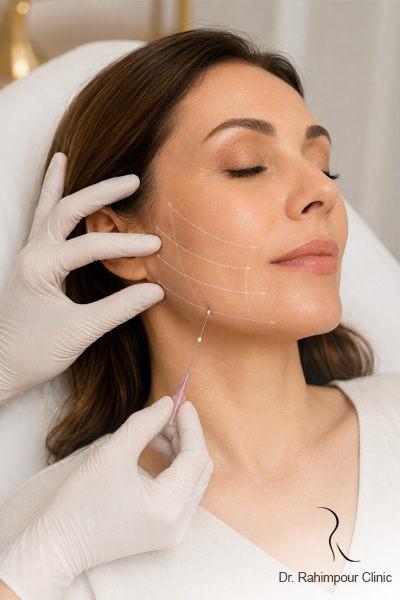
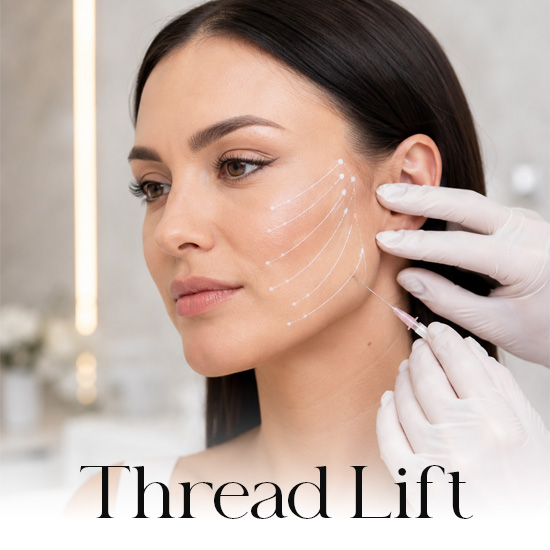
A thread lift is a minimally invasive procedure designed to produce limited elevation and support of mildly descended facial tissues. Specially designed sutures are inserted through small entry points and positioned beneath the skin. Barbs, cones, or other surface structures engage the surrounding tissue to provide mechanical suspension. Many modern thread-lift devices are absorbable and are made from materials such as PDO, PLLA, or PCL.
Thread lifting may be considered in carefully selected patients with mild-to-moderate skin laxity, early jowling, reduced jawline definition, limited midface or brow descent, and selected early neck changes. The degree of correction is considerably less than that achieved with a surgical facelift. Thread lifting cannot remove excess skin, reliably reposition significantly descended deep tissues, or adequately correct advanced facial and neck laxity.
Some elevation may be visible immediately after the procedure, although early swelling, tension, and skin dimpling can temporarily affect the appearance. The result is more appropriately assessed after swelling has subsided and the tissues have adapted. Absorbable sutures gradually degrade and may produce a limited fibrotic or collagen response around the thread pathway, but the degree and clinical relevance of this response vary between patients.
Thread-lift results are temporary. Published estimates of longevity vary considerably according to the thread design, technique, patient age, skin quality, tissue weight, and facial movement. Some improvement may decline within months, while selected patients may retain a degree of correction for longer. Current evidence supports a limited lifting effect in appropriately selected patients, but high-quality long-term data and clear evidence that one thread material is superior to another remain limited.
Types of Threads
PDO – Polydioxanone: One of the most commonly used absorbable materials. PDO threads are available in smooth, twisted, and barbed designs. Barbed threads are generally used for mechanical suspension, whereas smooth threads do not usually produce meaningful lifting and are primarily used for a tissue-stimulation concept.
PLLA – Poly-L-Lactic Acid: An absorbable material that remains in tissue longer than some PDO products and may be associated with gradual tissue response.
PCL – Polycaprolactone: A more slowly degrading absorbable material. Its effects are still temporary, and comparative evidence proving superior clinical longevity remains limited.
Absorbable Suspension Sutures: Some products incorporate cones or other fixation structures specifically designed for soft-tissue suspension. Their indications and placement technique depend on the individual device.
Non-absorbable Threads: These are less commonly used in contemporary aesthetic practice because persistent material can make complications or later removal more difficult. Published data suggest higher risks of extrusion and paresthesia with non-absorbable compared with absorbable threads.
Procedure Essentials
Session Duration
Usually 30–60 minutes, depending on the number of threads and treatment areas
Anesthesia
Local anesthesia, sometimes combined with topical anesthesia
Recovery Timeline
Several days of swelling, bruising, tenderness, or tightness; complete settling may take several weeks
Aesthetic Results
Partly immediate and partly apparent after swelling subsides and tissue tension settles
Longevity
Temporary and variable; depends on thread design, technique, tissue quality, and aging
Repeat Interval
Considered only after the result has diminished and tissue condition has been reassessed
Clinical Considerations
Patient selection, tissue weight, insertion plane, nerve and vascular anatomy, and direction of suspension
Number of Sessions
Usually one initial procedure; correction or repeat treatment only after clinical reassessment
Thread-Lift Aftercare
• Rest: Limit activity during the first several days and avoid movements or activities that create pressure or tension across the face.
• Head Elevation: Sleep on your back with the head elevated during the first nights to reduce swelling.
• Sleeping Position: Avoid sleeping face-down or placing direct pressure on treated areas until cleared.
• Touching and Massage: Do not massage or press along the thread pathways unless specifically instructed.
• Facial Movement: Avoid excessive mouth opening, forceful yawning, vigorous chewing, and exaggerated facial expressions during early recovery.
• Diet: Consider softer foods during the first several days to reduce forceful jaw movement.
• Exercise: Avoid strenuous exercise, heavy lifting, and inverted positions until medically approved.
• Excessive Heat: Avoid saunas, hot tubs, very hot showers, and excessive heat during initial healing.
• Cold Compresses: When advised, apply gentle indirect cooling without pressing on the threads.
• Entry Sites: Keep insertion points clean and dry and avoid picking or contaminating them.
• Cleansing: Wash the face gently and avoid scrubbing, brushes, or direct pressure.
• Makeup: Resume makeup only after the entry sites have closed and according to medical advice.
• Medication: Take prescribed antibiotics, analgesics, or other medication exactly as directed.
• Blood-Thinning Medication: Do not discontinue or begin aspirin, NSAIDs, anticoagulants, or antiplatelet medications without consulting the prescribing physician.
• Alcohol and Nicotine: Alcohol and nicotine may increase bruising, inflammation, or impaired healing and should be limited.
• Dental Treatment: Postpone elective dental procedures requiring prolonged or wide mouth opening according to your physician’s advice.
• Facial Treatments: Avoid facial massage, facials, RF, HIFU, laser, microneedling, and other pressure- or energy-based treatments until cleared.
• Hair and Scalp Care: Avoid pulling, pressure, or vigorous manipulation near entry points, particularly in the temporal or hairline regions.
• Dimpling: Mild skin puckering may occur during early healing. Do not attempt to release or massage it without medical instruction.
• Early Asymmetry: Swelling and tissue tension may create temporary asymmetry.
• Final Assessment: The result should be assessed after swelling and initial tension have settled.
• Follow-up: Attend follow-up visits for assessment of entry sites, symmetry, facial movement, infection, dimpling, and thread position.
Warning Signs
Contact the treating physician promptly for:
• Severe, persistent, or increasing pain
• Severe, one-sided, or progressively increasing swelling
• Spreading redness, warmth, purulent discharge, unpleasant odor, fever, or chills
• Visible or extruding thread
• Severe or persistent dimpling, folding, or contour irregularity
• Progressive or marked asymmetry
• New facial-muscle weakness, lip or eyebrow drooping, or impaired movement
• Severe numbness, persistent paresthesia, or neuropathic pain
• A painful mass, abnormal firmness, or prolonged inflammatory reaction
• Skin discoloration, impaired perfusion, or skin breakdown
• Difficulty opening the mouth, swallowing, or speaking
• Hair loss or scalp injury along a temporal thread pathway
Contraindications & Precautions
Principal Contraindications
• Active infection involving the face, scalp, or planned insertion pathway
• Open wounds or severe active skin disease within the treatment area
• Known hypersensitivity to the thread material, anesthetic, or required procedural agents when no safe alternative exists
• Severe or uncontrolled coagulation disorder
• An uncontrolled medical condition that makes an elective minimally invasive procedure unsafe
• Inability to comply with postoperative restrictions and aftercare
• Any product-specific contraindication stated by the manufacturer
Conditions Requiring Additional Caution or Medical Assessment
• Pregnancy: Elective cosmetic thread lifting is generally postponed until after pregnancy.
• Breastfeeding: Because available evidence is limited, treatment should be considered individually.
• Anticoagulant or antiplatelet therapy or a bleeding disorder
• Active or uncontrolled autoimmune or connective-tissue disease
• Immunosuppression or medication that impairs wound healing
• Uncontrolled diabetes
• History of keloid formation, hypertrophic scarring, or abnormal wound healing
• Active dermatitis, eczema, psoriasis, severe acne, or other inflammatory skin disease
• Active herpes simplex or herpes zoster infection
• Recurrent infection or suspected filler-related biofilm
• Permanent filler, silicone, biopolymer, or unknown injectable material within the intended thread pathway
• Recent filler treatment, fat grafting, thread lifting, or facial surgery
• Previous facial palsy, nerve injury, muscle weakness, or sensory abnormality
• Very thin skin, increasing the risk of thread visibility or palpability
• Heavy tissues or advanced laxity unlikely to respond adequately to thread suspension
• Significant facial volume loss, where skin traction without volume restoration may create an unnatural result
• Marked pre-existing facial asymmetry
• Previous facial surgery with significant scarring or altered tissue planes
• Implants, plates, screws, or devices within the proposed insertion pathway
• Active malignancy or a suspicious lesion within the treatment area
• Untreated body dysmorphic disorder, psychological instability, or unrealistic expectations
Potential Adverse Effects
Common adverse effects include swelling, bruising, tenderness, tightness, temporary asymmetry, skin dimpling, palpable threads, and localized sensitivity. A systematic review and meta-analysis reported swelling as the most frequent complication, followed by dimpling, paresthesia, thread visibility or palpability, infection, and extrusion. Reported rates vary substantially according to thread type, technique, operator experience, follow-up duration, and study definitions.
Less common but important complications include abscess, granuloma, foreign-body reaction, thread migration, extrusion or breakage, persistent contour irregularity, salivary-gland injury, vascular or facial-nerve injury, alopecia, and the need for thread removal. Management may require tissue release, trimming or removal of a thread, antibiotic treatment, drainage, or, in complicated cases, surgery.
Important: A thread lift is not a non-surgical facelift equivalent. It is intended to provide limited correction of mild-to-moderate tissue descent, and its effect is temporary and less predictable than a surgical facelift. Appropriate patient selection, anatomical knowledge, correct tissue-plane placement, and the ability to recognize and manage complications are more important than the number or commercial brand of threads used.
Patient Testimonials
Refined Results. Confident Experiences.
Answers to Common Questions
The most suitable treatment depends on your facial anatomy, skin condition, aesthetic goals, and medical history. During consultation, the treatment plan is tailored to your needs to ensure natural-looking and medically appropriate results.
Most non-surgical treatments involve minimal discomfort. Depending on the procedure, topical numbing, local anesthesia, or comfort measures may be used to improve the treatment experience.
Downtime varies depending on the treatment. Some procedures allow an immediate return to daily activities, while others may involve temporary redness, swelling, bruising, or sensitivity for a short period.
Some treatments provide visible improvement shortly after the session, while others develop more gradually over several days or weeks. The timing depends on the treatment type and the body’s natural response.
The longevity of results varies based on the procedure, treatment area, skin quality, and individual metabolism. Some treatments may last several months, while others may require periodic maintenance for optimal results.